Blog

The Language of Drawing II
I'd like to elaborate on last week's discussion about the language of drawing.
Here is the breakdown of the nose again. In the language of drawing, these lines depict the extent of the major planes of the nose:
|
Line 1 (the contour) shows the extent of the top plane.
Lines 2-6 say, "the surface bends here" or, put another way, there are two planes that meet at this line. |
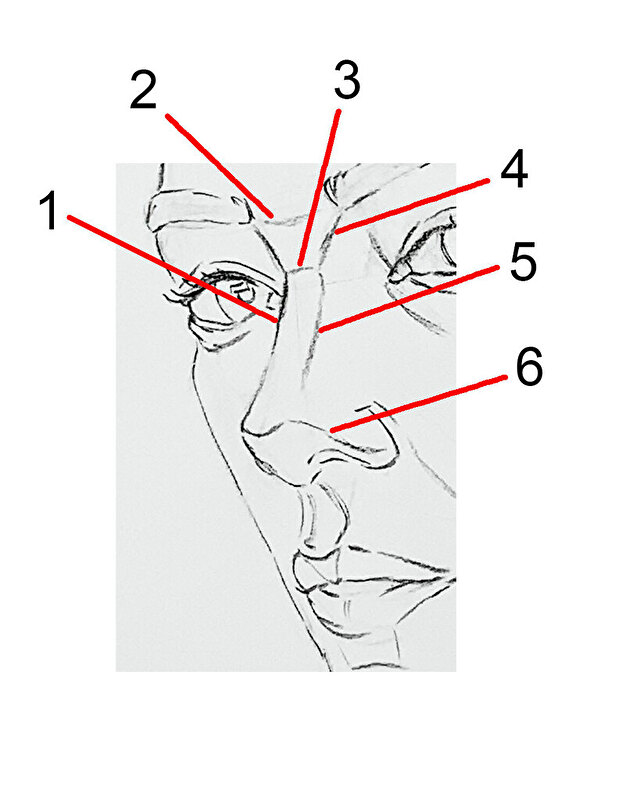 |
All well and good. However, to utilise this approach requires either keen observation or good working knowledge... or usually, both.
Referring to the above diagram, we would only see lines 4, 5 and 6 clearly if the side of the nose was in shadow, in which case the lines would be the edges of the shadow shapes. Most of the time, though, we don't see those plane boundaries very clearly.
We would almost never see lines 2 and 3, yet we know they are there. Close observation might reveal a shift in skin colour or temperature that gives us a clue that there are plane changes occurring somewhere in those areas, but there is definitely not a clear line to be seen.
In this way, our drawing becomes not only a visual description of the nose to the viewer, but also a display of the artist's knowledge of where and how planes change. If the artist doesn't know the plane changes, they won't see them, and won't depict them.
This is where anatomical knowledge is so important in life drawing. The more we know the location and shape of the deltoid, tricep, bicep, etc. then the better we will draw the arm. Whether we depict those muscles or not - we will be looking at the model through the lens of that knowledge. Knowledge informs our observations.
How does this translate to painting?
In more traditional, representational painting, there are no lines - because there are no lines in nature. Lines are a human invention. Instead, the theoretical "drawing lines" are the boundaries where patches of colour meet. For example, the top plane of the nose will have a different value to the side plane, and will also be a slightly different temperature. The boundary between those two colour-patches is rendered as line 5 in the above diagram.
|
Let's look at John Singer Sargent's portrait of Henry James. The top plane of the nose is mostly a single colour-shape, as is the side plane. The boundary of those two colour-shapes is line 5 in my diagram.
In painting, then, the edges of the brushstrokes can be read in the same way as the lines in a drawing. They depict plane changes and at the same time display the artist's knowledge of those plane changes. |
 |
We are still "drawing" in representational painting, although not in terms of lines, because when painting, we are actually dealing with shapes. The lines are implied by the boundaries between the colour-shapes, usually formed by the edges of the brushstrokes. I say usually, because brushstrokes can be blurred and softened for smoother transitions between the colour-shapes, yet the (now softer) boundary remains visible. That's why edges of brushstrokes are vitally important. Get those wrong, and the drawing within the painting falls apart and the structure collapses.

